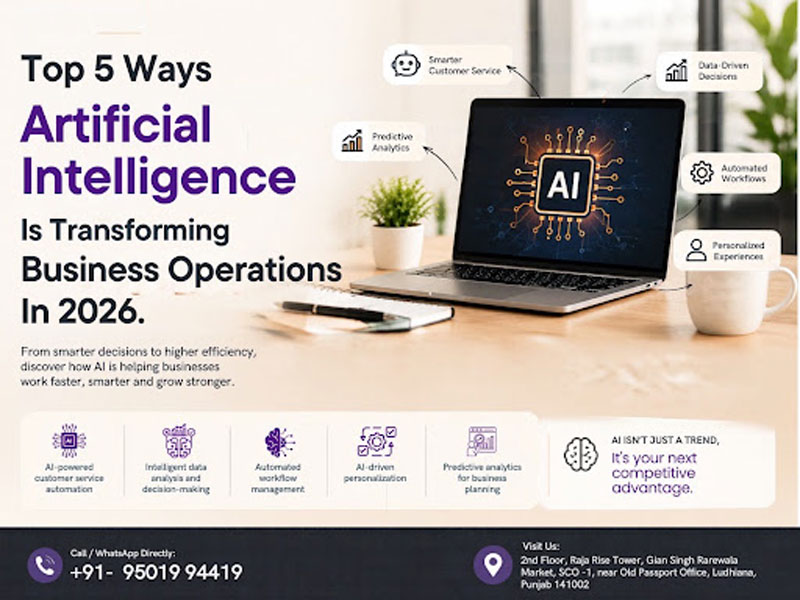
Artificial intelligence has become one of the most influential technologies shaping modern businesses. In 2026, companies are no longer looking at AI as just an experimental tool. Many organizations are using artificial intelligence to improve daily operations, understand customers better, and make faster business decisions.
The growth of AI for business is driven by a simple need: companies want to work smarter. By combining automation, data analysis, and intelligent systems, businesses can reduce manual effort while creating better experiences for employees and customers.
Customer service is one of the areas where businesses are seeing immediate benefits from artificial intelligence. Customers today expect quick responses and solutions available at any time. AI-powered chat systems and virtual assistants help businesses respond to common questions, guide customers through simple processes, and provide support outside traditional working hours.
These systems can handle repetitive requests while allowing customer service teams to focus on more complex issues that require human attention. The goal of AI automation in customer service is not to remove human interaction. Instead, it helps businesses create a faster and more efficient support system where technology and people work together.
Every business collects data, but the real challenge is understanding that information and turning it into useful decisions. Artificial intelligence can analyze large amounts of data much faster than traditional methods. It helps businesses identify customer behavior patterns, market trends, and operational challenges.
For example, companies can use AI-based analytics to understand which products perform well, which marketing campaigns generate better results, and where improvements are needed. This ability to make decisions based on accurate insights is becoming a major part of business transformation. Companies that use data effectively can respond faster to changing customer needs and market conditions.
Many organizations still spend significant time on repetitive tasks such as scheduling, document processing, reporting, and internal communication. AI automation helps simplify these processes by reducing manual work and improving workflow efficiency.
Businesses can use AI-powered systems to organize information, automate approvals, manage tasks, and improve communication between departments. When routine activities become easier to manage, employees can focus more on strategic responsibilities that require creativity and problem-solving. This shift allows companies to build more productive teams while maintaining consistent operations.
Customers expect businesses to understand their needs. Generic marketing messages and one-size-fits-all experiences are becoming less effective. Artificial intelligence solutions allow companies to create more personalized interactions by analyzing customer preferences, browsing behavior, and previous interactions.
For example, online businesses can recommend products based on customer interests, while service providers can offer more relevant suggestions based on customer history. Personalization helps businesses create stronger connections with customers because people are more likely to engage with brands that understand their requirements.
One of the most valuable advantages of AI is its ability to predict future possibilities. Businesses can use predictive analytics to estimate demand, identify risks, and prepare better strategies. For example, retailers can forecast product demand, financial teams can analyze future trends, and companies can improve resource planning.
Predictive analytics helps businesses move from reacting to problems toward preparing for future opportunities. In 2026, companies that use AI for business planning can make more informed decisions and adapt more effectively to changes in their industry.
Implementing AI does not mean every business needs to completely change its existing systems. The best approach is to identify specific challenges where AI can provide meaningful improvements.
Companies can begin with simple applications such as customer support automation, workflow optimization, or data analysis tools. A successful AI strategy requires clear goals, suitable technology, and proper implementation. Businesses should focus on solving real problems instead of adopting AI only because it is a popular trend.
Artificial intelligence delivers the best results when combined with proper planning and digital expertise. Businesses need solutions that match their goals, customer needs, and operational requirements.
Wolffia Technologies helps businesses strengthen their digital presence through technology-driven strategies, digital marketing, and modern business solutions. By understanding each company’s unique challenges, the team helps organizations use technology more effectively.
For businesses exploring artificial intelligence solutions, working with an experienced digital partner can make the adoption process smoother and more practical.
AI for business refers to the use of artificial intelligence technologies to improve operations, automate tasks, analyze data, and support better decision-making.
AI automation reduces repetitive manual work by handling tasks such as customer responses, workflow management, reporting, and data processing.
Yes. Small businesses can use AI solutions for marketing, customer support, analytics, and operational improvements without requiring large technology systems.
AI analyzes large amounts of information and identifies patterns that help businesses understand trends, customer behavior, and future opportunities.
AI is becoming an important part of modern business operations because it helps companies improve efficiency, create better customer experiences, and adapt to changing markets.





Leave A Reply Now